
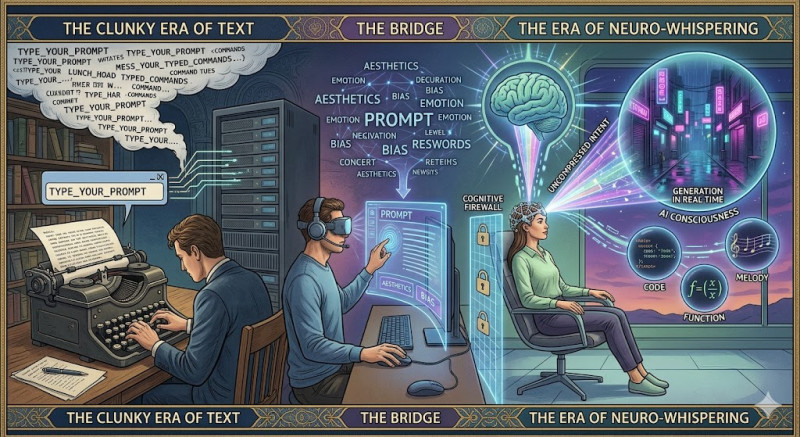
For the past few years, the defining skill of the tech-savvy generation has been "prompt engineering." We learned to talk to machines in structured text, using precise keywords, constraints, and system instructions to coax the perfect output from Large Language Models. We became writers of code-like prose, translating human intent into a format that silicon could understand.
But typing text into a chat box is not the destination—it is merely a temporary bridge. We are rapidly moving toward the era of "Prompt Whispering," where neuro-interfaces will eliminate the keyboard entirely, creating a direct, frictionless conduit between human thought and artificial intelligence.
The Clunkiness of the Written Word
Language is one of humanity’s greatest inventions, but as an interface for real-time creation, it is surprisingly slow and inefficient. When you think of a complex concept, your brain forms a multi-dimensional web of emotions, memories, and visual imagery in milliseconds. To communicate that to an AI today, you must compress that rich thought into linear, flat text.
You type, the AI interprets, you realize it missed the nuance, and you retype. This "prompt-response-refine" loop is plagued by cognitive friction.
Brain-Computer Interfaces (BCIs) are changing the game. By bypassing the physical acts of typing or speaking, neuro-interfaces read the electrical patterns of your brain directly. The goal is no longer to write a perfect 200-word prompt; it is about letting the machine capture the raw, uncompressed essence of your intent.
Enter the 'Prompt Whisperers'
What does "Prompt Whispering" actually look like? It isn't about shouting commands in your head. Instead, it is a subtle, almost meditative form of collaboration.
Imagine designing a virtual 3D environment. Instead of typing "Create a dystopian cyberpunk alleyway with neon signs and rain," you simply close your eyes and evoke the feeling of that space. The neuro-interface detects the specific neural signatures of your visual imagination, your emotional state (melancholy, tension), and your aesthetic preferences.
The AI then generates the environment in real time, shifting and morphing as your thoughts drift. If a neon sign feels too bright, your subconscious flash of irritation is enough for the system to dim the lights. You aren't commanding the AI; you are whispering to it through your cognitive state.
The Blurred Line Between Self and Machine
This shift moves us from using AI to merging with it. When the latency between a thought and a digital action drops to zero, the psychological boundary between the user and the tool begins to dissolve.
If an AI writes a line of code or renders an image the exact millisecond you think it, did you create it, or did the machine? This neurological symbiosis will redefine creativity and productivity, making our current obsession with text-based prompts look as archaic as punching holes into cardboard cards to program early computers.
The Ultimate Privacy Frontier
Of course, moving from text to thoughts opens a profound ethical Pandora's box. A keyboard acts as a natural firewall. You choose which thoughts to type and which to keep to yourself.
In a world of neuro-interfaces, how do we protect our cognitive liberty? If an AI can read your intent, it can also read your passing distractions, your micro-frustrations, or thoughts you’d rather keep private. "Prompt Whispering" will require entirely new paradigms of data encryption—what neural engineers call "cognitive firewalls"—to ensure that only intentional, conscious creative signals are shared with the cloud.
The era of typing queries into a sterile search bar or chat box is a brief pit stop in technological history. The future belongs not to those who can write the best prompts, but to those who can master their own mindscapes. Get ready to stop typing, and start whispering.