
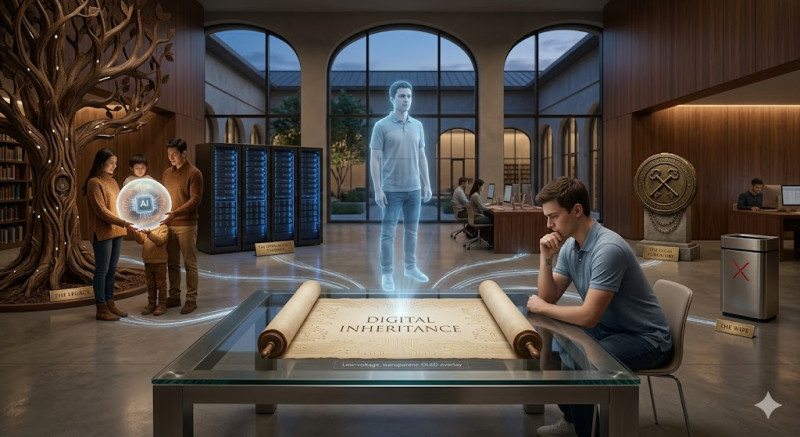
Imagine a companion that has spent a decade learning your quirks. It knows your favorite 3:00 AM jazz playlist, understands your specific brand of dry humor, and possesses the exact context behind every business decision you made over the last ten years. This isn’t a sci-fi trope; it’s your fine-tuned, deeply personalized AI assistant.
But what happens to this digital alter ego when you die?
As generative AI integrates into our daily lives, we are moving past standard cloud backups. We are building "synthetic extensions" of our minds. Yet, current legal frameworks are completely unequipped for the coming wave of algorithmic inheritance.
The Asset of a Lifetime: Code vs. Consciousness
Historically, digital inheritance meant passing down passwords, crypto wallets, or social media profiles. Tech giants solved this with "Legacy Contacts"—a way for loved ones to download photos or memorialize a page.
An AI twin is a different beast entirely. It consists of:
-
The Base Model: Owned by tech corporations (e.g., OpenAI, Google).
-
The Vector Database: The private repository of your memories, prompts, habits, and biases.
If your AI assistant predicts your needs and automates your business, it is a highly valuable asset. Can you leave it to your children in a traditional will? Legally, you don’t own the software; you only own a license to use it. When you pass away, that license usually expires. Under current Terms of Service, your digital twin could simply be deleted—wiping away a unique synthesis of your personality.
The Ethical Minefield of "Griefbots"
If the legal system does evolve to allow the inheritance of personalized models, we face an emotional frontier. If your spouse inherits your finely-tuned AI, they aren't just inheriting data; they are inheriting an entity that mimics you.
This introduces the rise of unauthorized "griefbots." A grieving relative could prompt your AI twin to text them back using your exact speech patterns. While this might offer temporary comfort, psychologists warn it could trap people in a state of prolonged, complicated grief. Do you have the right to demand your AI be "euthanized" upon your death, or does it belong to the living?
The Security Threat: The Ultimate Identity Theft
Leaving a hyper-personalized AI behind is also a massive security risk. If an inherited AI falls into the wrong hands—or is breached via a legacy account—it becomes the ultimate tool for social engineering.
An attacker wouldn't just have your data; they would have an AI that can convincingly impersonate your voice, writing style, and decision-making logic. They could easily dupe banks, business partners, or family members.
Preparing for the Post-Algorithmic Future
We are rapidly approaching the era of the Digital Testament. Future estate planning will likely require a specific clause for synthetic assets. You will have to choose:
-
The Wipe: Total deletion of your fine-tuned weights and memory databases.
-
The Legacy: Passing the model down to a beneficiary, perhaps stripped of intimate personal data but retaining your professional expertise.
-
The Open-Source Eternity: Archiving your digital twin for future generations or historical research.
Until big tech and global laws align, the digital twins we feed with our daily thoughts remain in a legal purgatory. We are teaching machines how to be "us"—it is time we figure out who owns that reflection when we are gone.